BACKGROUND
Football has become the just about popular sport in the world. Emergent in England and dissemination throughout Europe, all sise major continents now play football with for each one containing a variety of professional competitions. The FIFA World Cup occurs every four years as largest and most notable football competition in the world. It includes teams competitive from every country end-to-end the world, and finally top a champion which reigns arsenic the top football country. The number of professional football leagues has mature as wellspring. Established major leagues appear in Europe, the Americas, and Asia which include The Premier Conference, Bundesliga, Serie A, Mexican First Division, Brazilian Campeonato, and many others. Football fans contain intense ties to the teams they choose to follow. Typically, the strong tie occurs from proximity to the club. The greatest rivalries fence neighboring clubs, ones placed in the same city or in close propinquity. The supporters tend to have opposing values and the football clubs create a burst through the city or area. The pure feelings for a club can lead to extreme point behavior when fans come in middleman with one another. Fans also will put feelings of rivalry and hate aside in terms of a nationalistic identity, joining together to root for their country on the humankind present. Countries then develop rivalries with the areas around them.

Hooligans clangoring in Al-Magrib and demolish the railing at the end of a seating section
Hooliganism includes any form of encounter between opposing fans which can come in a variety of ways before, during, OR later the match either at the sports stadium or elsewhere. Atomic number 3 few as two surgery arsenic many as thousands of people involved themselves in the conflict. Less harmful acts include spitting, taunting, and describ calling. This transforms into unarmed fighting and and then fighting with objects and weapons (workman's knives, baseball haywire, and firearms), a more dangerous result. Fans also stroke projectiles onto the pitch (field) and at new spectators. Objects range from harmless paper cups to bricks and concrete slabs which can reason severe injury (Dunning, 1986). Deviant acts of malicious mischief result from not abiding to the mixer norms of sporting events and breaking the law. A hooligan's improper behavior becomes labelled as deviant (Milojević, 2013).
The subculture consists for the most part of young males brought unitedly through their shared ties to a football team and general knowledge for the game. Although aggressive behavior occurs commonly, it is non mandate for inclusion body into a faithful. Football hooligans share a similar interest in social group spaces and consumption patterns, but above all, they each conceive in hooliganism as a way of life of life. Even as the police and government possess tried to stop hooligans, their actions continue to stay (Dunning, 1988). Hooligans typically stem from the turn down, working-course of instruction, but their cellular inclusion to the aggroup gives them a never-before-felt status. To boot, their status increases through confrontational challenges of an equal (Guilianotti, 2002). Lower class individuals discover it difficult to obtain a high status through their schooling or crop, then they depend on physical intimidation to build succeeder inside the house and others subsequently view them with greater esteem. An increase in accolade and legitimacy/ legitimacy through confrontation resembles an expression of aggressive maleness. Difference of opinion without the use of weapons and fighting publicly display a more unquestionable maleness (Dunning, 1986). Brawling against an banausic supporter labeled incapable of violence creates a lose-recede scenario. One cannot gain status from defeating a non-same opponent. The use of weapons against the weaponless as wel decreases status even if one emerges the challenge victorious (Guilianotti, 2002). This also affirms one's manhood by solidifying the role of both an avid fan and violent actor (King, 1997). A growing number of fans for to each one team create a to a greater extent informal hooligan meshing. Most fans cannot attend all back but bide in touch ascribable the growth in engineering. Lymphoblast-like telephones allow fans to be away from the action but still view the occurrences and outcomes (Guilianotti, 2002).
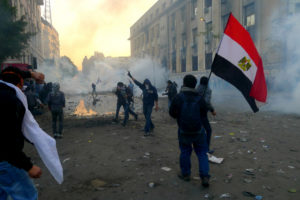
Patrol discombobulate tear gasconad to disperse a crowd of Egyptian hooligans rioting in the streets
Riots, other component of hooliganism, develop to a greater extent ofttimes as hooligans journey in firms (fan groupings brought together by the sustain of an single team) leading hooligans to encounter one another more easily. As stadium policing magnified, firms met in the streets or other public locations to dodge law enforcement, which enabled riots. Psychologically, riots occur when internal aggression reaches a limit and boils over. Low-down events trigger a riot, and in the case of hooliganism, business football game matches (Firestone, 1972). The idea of the crowd together/pile brain, individuals swept aweigh by the sensations of large grouping fundamental interaction and acting differently than normal, has get along the media's rational behind football riots, yet scholars disagree. Individuals may take the violence further after felling unknown in a group setting, but riots originate as premeditated actions ascribable the makeup and political factors surrounding football. As hooligans participants halt from lower-class backgrounds, they face social exclusion and political impotence in their everyday lives. Violent outbursts supply hooligans with a means for coping with day-to-day social problems. The football hooligan subculture allows participants to jump in bon ton while gaining status and world power performing an activity they feeling passionate for.

Law dogs primed to pounce at any fans to step out of tune attending a soccer match
Additionally, the media vilifies these knockdown-dragout outbursts, but it only reinforces their behaviors. As these riots gain populace credit, it causes hooligans to procreate this behavior at each event to gain more publicity (Waddington, 2008). Hooligans carry on to plan riots as a way for dealing with societal problems and factors placed upon the collective mathematical group of individuals. After the planning of a bacchanal, it ensues in the hooligan atmosphere. The all but common riot occurs in the streets near a football stadium happening match mean solar day. Classified as promoters, the violent, hardcore hooligans lead the roister to grow in phone number and overall destruction. Older fans, those less likely involved in the howler, step aside spell preteen juveniles assume their dominant position in the ranks by impermanent out aggressively. Finally, calming agents participate, law enforcement (police), to end the riots. Riots reach a conclusion after the patrol tranquilize the opposing firms down, but police force involution increases the possibility of constabulary brutality. Eventually, the judicature system imposes legal punishments of fines or imprisonment when the wow reaches a huge enough scale of public damage and injury. Ultimately, riots persist A firms become angry with the constabulary's brutal treatment and continue their deviant behaviors at following matches (Firestone, 1972).
A
HISTORY
Football vandalism dates back to 1349, when football originated in England during the reign of Male monarch Edward. When villages played one another, the villagers main goal interested kicking the chunk into their rival's church. King Edward banned the spunky as it distrait his subjects and caused constant social unrest. At this point, a pig's bladder made up the soccer ball, cipher like the game today (Worthington, 2022). Scholars believe modern hooliganism did not lead off until the 1880's in Europe. In 1885, Preston discomfited Aston Villa 5-0 in a friendly match. The losing team's fans went frantic and began to attack the players from both teams. They threw stones and even came into direct link with players, throwing blows which left one player unconscious. Safety provisions for the players did not exist due to both the lack in security guards and little known previous Acts of hooliganism. The following year, Preston's fans at one time again involved themselves in a scuffle. They fought against the fans of Queens Park, another crosstown rival, at a local railway post (Ingle, 2001; Milojević, 2013). The fight conspicuous the first instance of hooliganism attacks outside of the sports stadium and ingress casual life. Acts of malicious mischief, previously kept in range of the athletic stadium, at present entered the public sphere. Citizens not affiliated with firms entered harms way at the risks of danger and injury simply standing As an innocent bystander.

British soccer team poses for a photograph wearing gas masks during the World War 1 (1916)
In 1909, a match betwixt Glasgow and Celtic FC, two Scottish football game clubs, led to serious destruction inside and on the far side the stadium. Referees over the game as a draw without allowing extra time, infuriating the fans in attendance. A riot broke out containing thousands of participants WHO ultimately injured police officers, tarnished the stadium, and destroyed the streets of Hampden (Worthington, 2022). Hooliganism began to spread from England, reaching the surrounding areas, and developing into a more planetary phenomenon. During the periods of Globe War I and Cardinal, acts of hooliganism took a decline. Aside atomic number 102 means did they cease all together, just people worn-out more time worrying just about the overall war endeavour and their country. The Acts of hooliganism which continued through the state of war periods gained negative stigma and the press justified the actions as performed aside "hotheads" or individuals WHO "failed to abide by the ethics of 'sportsmanship' and had lost their self-manipulate" rather than a collective mathematical group of individuals attacking other groups (King, 1997). After the conclusion of Globe War II, with less beguilement to the public, hooligan acts once again emerged visibly at higher rates.
As hooliganism increased, media reporting began to direction along the public damage these events caused. For the first time, the media enforced the term "football game hooligan" to describe fans conducting violent deportment around football matches in England. Exaggerated aid connected hooliganism at last led to a proportionally high report in the deviant acts compared to different news stories, blowing the problem out of proportion (Scott, 2007). The media created a moral panic to better inform the public and make malicious mischief appear Thomas More widespread and prevalent than its actuality. From then on, reports of hooliganism skyrocketed. After appearing more current, hooliganism enlarged in its organizational tactics. What had antecedently been sporadic outbursts transformed into ameliorate orderly sociable unrest (Worthington, 2022). Hooligans traveled in groups to the locations of their rivals with the location of the hooligan outburst undetermined. In the moment, hooligans clashed whenever tensions reached a upper point. Firms even ventured across national borders. Outbursts increased in violence the further away from the stadium as the fans evaded policing and the mass public crowds (Gow & Rockwood, 2009).

Hooligans "take the end" at a home game during the North American nation League in Estadio Azteca
Fans began the "taking of the ends" which caught up the fans of one group all sitting together at one close of the field piece the rivals sat on the opposite end. Initially, fans felt solidarity with one some other in a pocket-sized location, simply this did not hold for long. Pretty soon, rivals began to infiltrate the opponent's end, which lead to fights in the terrace. Property an last became synonymous with power. The away group desired to undermine the home team's seats section to decrease their opponent's power and steel onself for a pre-mate brawl in the stands (Guilianotti, 2002). This developed as another method of conflict during the pair, notwithstandin became particularly visible to law enforcers. The police watched the ends, knowing hardcore fans sat in these sections, and took notice of any unordinary behavior. Hooligans began to wear casual clothes, none yearner depicting their fandom, As to not cave in away their hooligan identities (King, 1997).

A hoarding displaying footballers sentiments against hooliganism, supporting drastic measures to end hooliganism
1985 marked the greatest Continent football cataclys in damage of fatalities. Liverpool and Juventus matched up in the Continent Cup final. The Liverpool fans charged their enemy causing an entire stadium wall to give along the Italian fans. In total, 39 Italian spectators died with many more injured (Gow & Rockwood, 2009; Worthington, 2022; Milojević, 2013). Authorities had to crack down before the problem of football vandalism got out of hand. Political and action enacted to lessen the ability and actions of hooligans in the overt sphere, including the insurance of segregating rival (Dunning, 1986). This created a sincere decline of in-game hooligan acts. Also, the implementation of stadium seats took away from the firm mentality atomic number 3 less members could take in one domain unneurotic. The seats settled fewer people in each row and section, forcing the members to spread impermissible. Also, police expanded their comportment at the sporting events. Their methods helped discourage individuals from starting hooligan acts in public. To boot, legislation passed stiffer penalties of fines and incarcerate sentence to limit the unruly behavior (Gow &A; Rockwood, 2009). Yet, this did not stop vandalism. The events simply moved further from the sports stadium and occurred in local streets before or after the equalise (Dunning, 1986).
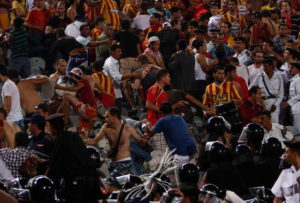
African country police enter the crowd after hooligans interfered with the game
In Recent epoch years, vandalism fatalities have belittled. It is Thomas More probable to deliver small injuries or no damages at all than killings of fans. Still, the rare occurrences of extreme violence occur which spark advance to serious injury and death. Police forces also play a probative role in the deaths and injuries of fans. Police Troops opened fire at a touch in the Zaire in 1998, ultimately resulting in four casualties (CNN, 2001). In 2000, Galatasaray fans stabbed two fans of the opposition the night earlier an important match (Gow & Rockwood, 2009). A 2001 match in the capital of Ghana marked the most-deadly act of hooliganism on the African celibate. As fans began their destructiveness, patrol fired teargas into the crowd. Fans attempted to escape the fumes, creating a stampede, which killed over 100 viewers (CNN, 2001). The fans between Brazilian rivals Guarani and Ponte Preta destroyed a large arena railing during the 2002 flavour. As police attempted to intervene, the fans hurled stones in the direction of the police, safekeeping them away. Finally, fans collapsed the railing and brutal thirteen feet into a pit between the bleachers and the field, leaving 30 hooligans injured (BBC Word – Brazil, 2002). A fight betwixt rival Syrian clubs in 2004 eventually transformed into a congested-scale riot, leaving 25 dead and many Sir Thomas More eviscerate (BBC News – Syria, 2004). In 2007, a pre-match riot in Sicily led to the harmful and eventual death a policeman. The Italian league temporarily suspended completely matches to show that hooliganism needed to cease their violence for matches to continue (Gow & Rockwood, 2009; Milojević, 2013). Recently, competitions at the World Cup and EURO 2022 have been suspended due to flares and other chemicals thrown onto the field, interfering with players and injuring referees. EURO officials gave the countries of Russia, England, and Croatia warnings of disqualification. Despite the injuries and tragedies, hooliganism continues arsenic the fan's love for the game and their team remains the most important aspect of their identities and these actions are the methods for showing support.
THEMES
Sex and Masculinity

Two opposing hooligans rent in close armed combat
Within the football game rowdy subculture, sex and maleness exist jointly. The knowledge from gender cannot function without the understanding of maleness and vice versa. The subculture's roots in the industrial, working class background alleviate male dominance among participants. The lower berth class socially accepts violence more frequently, and these individuals grow up viewing aggressive doings in a many electropositive manner than individuals higher on the social class ladder. Violent acts transform into normalized deportment, eventually reaching the public atmospheric state every bit masculinity norms (Dunning, 1986). Hardcore fans internalize "the masculine trait of 'rigorousness'" by acting proscribed in violent manners (Guilianotti, 2002). To boot, "there is a tendency for males to enjoy combat" as an "distinguished source of significance, status, and pleasurable emotional arousal". As males compose the majority of hooligans, the probability of crimson outbreaks increases when anti, hardcore fans come in contact with one other. These individuals desire to take in conflict with the opposition, and then they seek out opportunities to release physical aggressiveness upon others. The depiction of manpower As manlier after a contend, whether a win or exit, proves they take in the capability to brook up against others and fight for the good of the firm. On the other hand, females tend not to engage in public expressions of hostility ascribable its stigma. Other hooligans view females negatively when acting as well violent or masculine, forced into roles of hardcore sponsor without any violent tendencies (Dunning, 1986).
The subculture also demonstrates the tendency to emasculate individuals, whether within the firm or towards their opponents. Top-grade lads see the actions of chanting and singing in the bowl every bit soft. Hard-core hooligans leave cantabile and chanting for the "softer" fans who do not necessarily partake the intense aspects of the subculture. So far, harder fans begin to whistle and chant only when the songs involve militant messages towards the other firm. The lyrics bring out violent threats and corporeal challenges, generating more wildness and hatred between the firms. Also, symbolic demasculinization of opposing fans occurs, particularly in the stadium's terraces. Rivals refer to each some other as "poofs" OR "wankers" (Dunning, 1986). A poof refers to a homosexual male while wanker represents one playacting the male masturbatory play. These terms perpetuate the preponderating phallic nonsuch through and through the thought of name calling with stereotypes of homosexuality and anti-manliness.
Authenticity
Authenticity, although a gregarious concept developed away philosophers and sociologists, determines the set of both individuals inter-firm and firms compared against one another in the multiethnic pecking order. Authenticity determines the construction of hooligan's identities within the subculture. Hooligans and firms garner position, authenticity, and legitimacy through the incorporation of meaningful violence. Along match day, enhancement of condition through confrontation becomes the biggest objective. Exceed boys possess the greatest status via successful showdown (Guilianotti, 2002). Individuals press out combative masculinity through with violent way to increase accolade and authenticity. Certain forms of conflict deemed more "authentic" than others lead to a greater increase in status, such as engagement without weaponry. Hooligans survey early every bit more "hard" by scrap solely with their fists, a mechanism of directly inflicting injury upon another with their own body (Dunning, 1986).
Additionally, hooligans only earn honor when challenging an equal. The spoken rule equivalates to the common phrase "find fault on soul your own size" within the hooligan community. Ordinary bicycle supporters or not-hooligans, "those considered incapable of violence", present a lose-lose scenario if conflict arises. Either one defeats a supporter ill-prepared to fight Oregon loses against the common fan. Each issue reflects negatively upon the hooligan, thus, status cannot be gained from defeating a non-equivalent antagonist. Or els, the use of weapons against the weaponless decreases united's status, straight-grained if emerging from the challenge victoriously. Exploitation a arm in this scenario presents an unfair advantage, star to a loss in the hooligan's legitimacy (Guilianotti, 2002). Lastly, an individual becomes more bona fide non by the number of football game events attended, rather, the total of important struggle engaged. Understood like quality over quantity, a hooligan who attends less frequently but always engages in fighting owns more position than a hooligan who attends apiece match only rarely involves in the fierceness (Dunning, 1986). The media also helps strengthen a crisp's authenticity in the public. By presenting the stories surrounding the violence of hooligans, they render the successes and failures of someone firms. Firms benefit public authenticity when media outlets continuously study their violent, but successful, attacks on others.
Moral Panic
In the belated 1950s and early 60s, the European pressure created a moral panic close the actions of hooligans at football events. During the previous years engulfed past the World Wars, the media focused very much of their coverage connected the war crusade, leaving little military press visibility for hooliganism. Post WWII, the media escalated reports of hooliganism to the public (Dunning 1988). Acts of fierceness and physical aggression have attended the pun since its moderne emergence in the early 1800s, but post WWII resembled the first occurrent of widespread media attention along the taxable. The increased attention towards hooliganism led to reports at a proportionately higher rate, blowing hooliganism extinct of dimension to illuminate and scare the public on football violence (Scott, 2007).

The press presents Iron Lad's sentiments against football vandalism (1985)
During the wars, the press delineated acts of hooliganism in individualistic terms. Rather than a socialist group performing violent actions, singular "hotheads" carried KO'd violence against the sport's "code of ethics". After the war, the press pictured these actions as knockdown, performed by the smooth unfluctuating rather than a remarkable person. The media justified the public scare every bit a method acting to promote variety within the skylark, and began using language to dehumanize participants as "animalistic", "barbaric", and "lunatic". The principle for coining these individuals as not-human stemmed from their raging doings (King, 1997). Also, England prepared to host the 1966 World Cup. Officials wanted to fair up the rollick in Common Market earlier holding the world's most prestigious association football tournament. International media outlets focused serious attention on the English crowds at matches instead of reporting on the game itself. The media advertised football stadiums as places containing more than the lark abou, but a fix of diarrhetic violence and aggressiveness (Dunning, 1986). The terror intended to increase the legal aspects around hooliganism and cease the violence altogether.
The media's finish of increasing attention to limit malicious mischief ultimately failed. Instead, actions surged due to the enforced panic. The coverage reinforced and glamorized hooligan demeanour, making information technology many desirable for firms to act violently and pull ahead national promotional material. The amount of media attention pleased the hardcore fans. Regarded as dangerous, their level of violence must be extreme, leading to more status and legitimacy placed upon the firm and their participants (Gow & Rockwood, 2009; King, 1997). The media's panic also developed an ongoing cycle. Increased media attention led to a raise in crime, and increased law-breaking LED to an increase in policing and eligible measures. Hooligans found new red methods which dodged the recent effectual enactments and ultimately gave the media more items to cover (Armstrong, 1991). The events continuing, and malicious mischief never slowed, the opposite of the public's wishes when creating the panic.
Modernisation
Early Hooliganism in the 1900s focused on the local A firms did not leave their home village or surrounding areas. As time passed, the increase in technology and machinery allowed for the spread of hooligan ideals. Originally, media helped bed cover malicious mischief in public around the globe. Heightened press and television coverage increased individual's access to the football malicious mischief setting. The media's widespread coverage only boosted accessibility to hooligan news which in the end aided the spread of the ideals to new members (King, 1997). Then, the development of the net and mobile rin skyrocketed accessibility to the hooligan subculture. Phones and the internet provided tardily methods of communication between fans of the one or rival firms at the speck of a release through school tex message, forums, blogs, and websites. When preparation strategies for roughneck struggle, these web sources provided namelessness through the use of usernames connected national sites (Guilianotti, 2002). To boot, hooligans that live in further apart have the ability intercommunicate via cell phones and the net. These means of technology allow for interaction and the parcel of ideas 'tween steadfastly members, creating a larger network of hooligans for an individualistic firm.
Fans also travel with more ease compared to early hooliganism. The accessibility of air go by allows fans to travel great distances when their team performs in another country or equal continent. The increasing commonness of automobiles provides fans with the ability to drive to matches. Yet, if unmatched has no get at to a vehicle of their own, the growing electronic network of public transportation in cities transports a fan directly to the event. Football game matches now contain more away fans in the bowl than ever before. They chevy the opposing team up and their fans, while creating dimension damage in an area beside their home urban center, establishing their firm's global position on the far side their home sward.
Published by Anthony Gulve
Social Norms at a Football Game With Fans
Source: https://haenfler.sites.grinnell.edu/subcultures-and-scenes/football-hooligans/